 5 min
5 minWhat you’ll learn in this article
What Is an API? Breaking down the acronym, API stands for Application Programming Interface. In practice, it’s a set of rules that allows different software systems to “talk” to each other, securely, automatically, and in real time.
Too technical? Think about it like this:
You’re in a restaurant. You place your order with the waiter (that’s the API). The waiter passes your request to the kitchen (the system), and later brings back the dish, ready to serve.
You never had to go into the kitchen, but everything still happened perfectly. That’s how API integration works: systems communicate behind the scenes so things run smoothly on the surface.
In everyday business operations, APIs are everywhere. They connect your e-commerce with your inventory system. They update your CRM when a form is filled out. They generate invoices the moment a payment is received. This invisible infrastructure powers thousands of business workflows, and the best part? You often don’t need to write any code to use it.
Let’s explore how to put it into action. 😉
How to connect APIs from different apps
How API works in practice depends on the connection method. There are two main approaches:
1. Developing the integration from scratch
This route gives you full control. You or your dev team create a custom connection between systems, using the documentation provided by the apps’ developers. This approach works best when your needs are complex and your internal team has technical expertise.
However, it only works if the software you’re using offers open API integration – that is, public access to their API documentation and endpoints. Without that, it’s not possible to connect apps directly.
This option can be powerful, but it’s often time-consuming and expensive, which is why it’s more common in tech-driven or enterprise-level companies.
2. Using an API integration platform
This is the faster, easier, and more scalable option. With platforms like Pluga, Zapier, or Make, you can connect two or more apps with just a few clicks. No code needed. 🤯
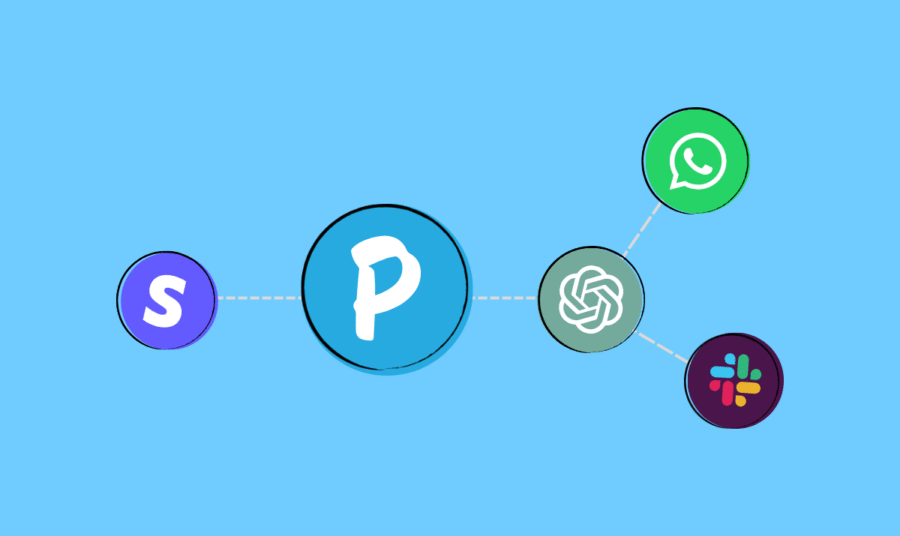
These API integration platforms rely on the open APIs of the apps you already use. You simply select the apps you want to integrate, define a trigger (like “paid order in Shopify”), and choose what action should follow (like “send a message on WhatsApp Business”).
This approach works perfectly for small and medium-sized businesses that need to streamline their operations without hiring a full development team.
Read too:
API examples: how automation works in real life
What is an example of an API integration?
Let’s say a customer places an order in your online store. Instantly, that order is:
- Logged in your accounting software
- Added to your CRM
- Confirmed via email
- Sent to your shipping system
- Updated in your inventory management tool
This is all done automatically through API integration. No manual steps. Just apps working together, behind the scenes, in real time.
Other common API examples in small businesses include:
- Syncing form submissions with email marketing tools
- Posting real-time sales data into a Google Sheet
- Sending Slack alerts when payments are received
- Creating tickets in your helpdesk when a bad review is posted
- Triggering onboarding emails when new clients are added to your CRM
These automations are already part of thousands of businesses and make up a major part of their operational efficiency.
What are the different types of APIs?
APIs can be grouped by industry (like payment APIs or CRM APIs) or by the technology used to build them. When people ask what is a REST API, they’re often referring to one of the most popular architecture styles. Here are the three most common types:
SOAP API
SOAP (Simple Object Access Protocol) is a structured and secure protocol often used by enterprises. It supports multiple transport methods, not just HTTP, and offers built-in error handling. It’s powerful, but more rigid and less modern than other approaches.
REST API
REST stands for Representational State Transfer. It’s currently the most widely used architecture for APIs, especially in SaaS products. It works over HTTP and uses simple methods like GET, POST, PUT, and DELETE. REST APIs are fast, scalable, and ideal for integration platforms.
CRUD
CRUD is a model for basic data operations: Create, Read, Update, and Delete. It overlaps with REST in functionality, but is not a full architecture by itself. It’s used in simpler or legacy systems and is less flexible for advanced automation needs.
Why do we need API integration?
Manual tasks are slow, prone to errors, and hard to scale. Copying data between apps takes time and often leads to mistakes. API integrations solve this by creating automated workflows across your systems.
The main API benefits include:
- Time savings: automate repetitive and low-value tasks
- Accuracy: reduce human error by syncing systems in real time
- Efficiency: streamline processes without hiring more people
- Scalability: grow your operations faster and smarter
- Visibility: get unified dashboards and consistent reporting
- Flexibility: build a tech stack that works the way you want
In short, API integration helps your business run smoother, faster, and with less manual intervention.
API integration without writing code
As mentioned earlier, you don’t need to be a developer to start using APIs. Platforms like Pluga offer API integration without code, giving you the tools to automate your workflows visually.
You pick the apps, define what should trigger the workflow, and choose what happens next. No technical setup. No dev team. Just results.
Explore all the Pluga’s apps and start automating process and manual tasks.
Final recap
Let’s quickly revisit the key points:
What is API integration?
It’s the technology that connects your apps and allows them to exchange data automatically.
How API works?
APIs act as messengers between systems, sending and receiving information in real time.
What is open API integration?
It refers to APIs that are publicly available and can be used by third-party tools or platforms to build connections.
What is a REST API?
It’s the most common type of API today — lightweight, fast, and ideal for scalable integrations.
Why do we need API integration?
Because automation reduces errors, saves time, and frees up your team to focus on high-value work.